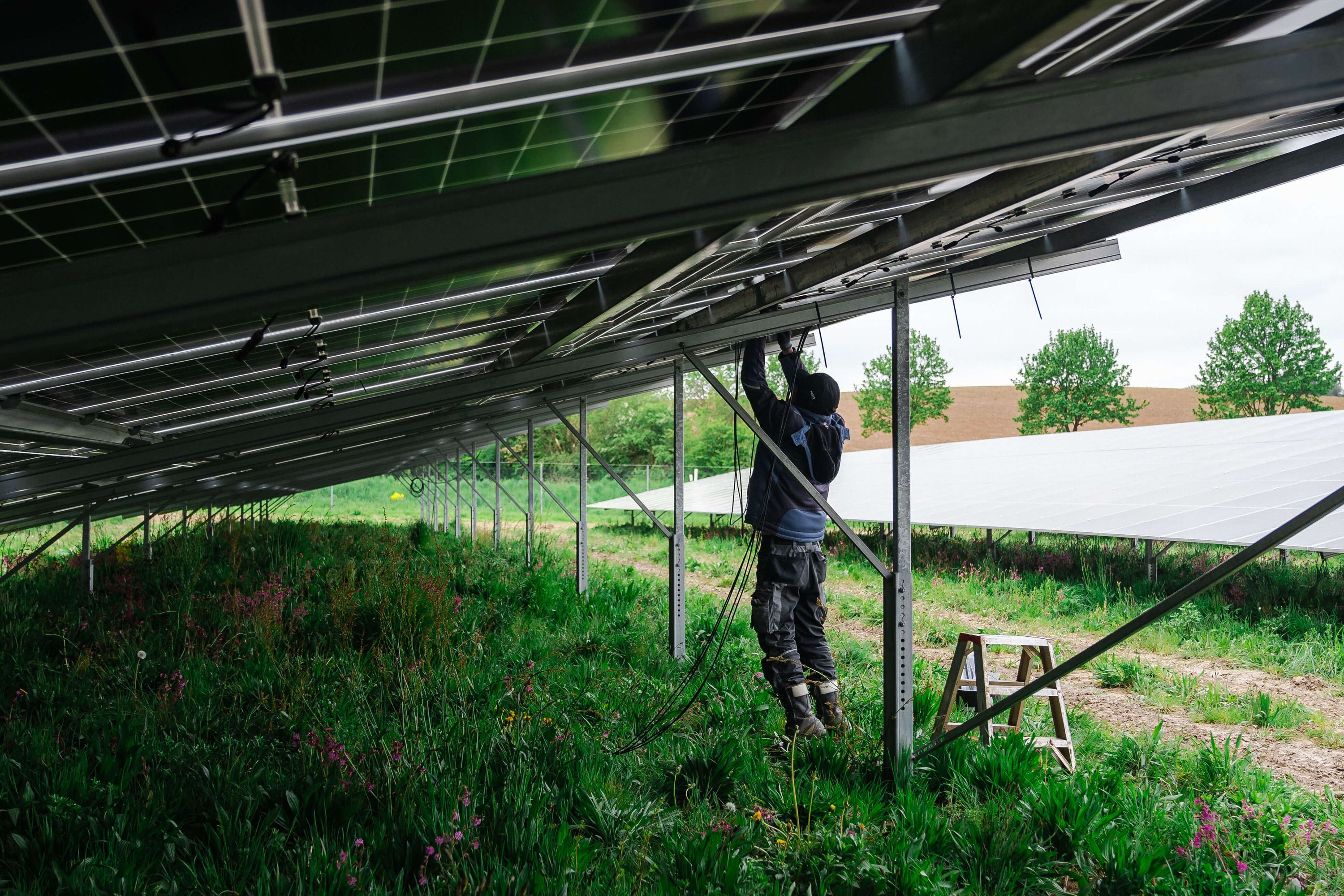
Pre-assembled cable harnesses vs. on-site assembly
Time is money – this old saying is especially true when installing solar power plants. Cabling is a critical cost factor that is often underestimated. But this is precisely where there is significant potential for savings: up to 20% of the total costs can be saved by using pre-assembled cable harnesses. How is this possible?
The hidden cost drivers of classic cabling
On-site assembly presents numerous challenges that have a direct impact on project costs. The time-consuming process of individually measuring, cutting and assembling each individual cable requires not only specially trained personnel, but also the appropriate special tools. Added to this are unavoidable material losses due to inaccurate cutting and quality fluctuations due to changing environmental conditions. Particularly critical: errors during installation, such as incorrect torque or poor crimping, can make expensive rework necessary.
The systematic approach: pre-assembly
Prefabricated cable harnesses offer a well-thought-out solution that increases efficiency on several levels. Installation is based on the plug-and-play principle, which drastically reduces assembly times. Special tools are no longer required, and weather-related delays are also significantly minimized.
Material efficiency benefits from precise digital planning: exact length calculations and optimized cable routing reduce waste to a minimum. Machine production under controlled conditions guarantees consistently high quality. Every work step is recorded, from crimping to final screwing.
Focus on long-term operational reliability
The added value of pre-assembled cable harnesses is particularly evident in long-term operation. The documented quality of each individual connection, manufactured under optimal conditions, significantly minimizes the risk of failure. The complete documentation not only facilitates any warranty claims, but also simplifies scheduled maintenance through uniform standards.
Economic Efficiency in Practice
The cost savings of up to 20% result from the interaction of various factors. The significantly reduced assembly time on site plays a central role. Added to this is the minimization of material waste through precise prefabrication and the reduced coordination effort during installation. Particularly important: Expensive rework, which is often required for on-site assembly, is almost completely avoided.
Conclusion: The difference is in the details
The analysis clearly shows: Prefabricated cable harnesses are much more than an alternative to classic installation. They are a decisive factor for the economic viability of modern solar projects. The key to success lies in professional planning and prefabrication. The full efficiency potential can only be exploited if the cable harnesses are precisely tailored to the specific project requirements.
Related posts

With our plug & play battery solution, we are paving the way to a more sustainable future
In a world that is increasingly looking for sustainable solutions, the energy sector faces the challenge of efficiently integrating and utilizing renewable energy sources. Energy storage plays a Energy storage plays a crucial role in bridging the gap between energy production and consumption. At ees Europe 2024, Europe's largest and most international trade fair for batteries and energy storage systems, HIS-Energy proudly presents its latest innovation: The Plug & Play Battery Solution, specifically designed for commercial and industrial applications.

How battery storage systems can reduce your electricity costs by up to 90%
In industrial operations, efficient management of energy costs is crucial. The use of energy storage systems, especially battery storage systems for peak shaving, plays a crucial role not only in minimizing energy costs but also in improving grid support and stability. For companies with annual operating hours below or above 2500, these methods offer significant savings potential.

Rely on safety when it comes to fire protection
The saying "safety first" is certainly very important in many areas of life. Everyone is talking about different topics: financial, private, professional. One aspect that concerns us all is fire protection. This level of safety in the event of a fire is particularly high in public buildings such as hospitals, care facilities or daycare centers.


What is Peak Shaving?
Peak shaving, also known as peak load capping, refers to the reduction of peak loads in electricity consumption, which can cause significant costs, especially for large industrial consumers. These peaks can be reduced by using commercial storage systems by supplementing the power supply during peak load times with the energy stored in battery storage systems.

4 Reasons to Use Lithium Iron Phosphate Batteries in Storage Systems
Battery cells in a conventional battery are connected to form a battery module, regardless of size and capacity. These battery cells are connected to one another to supply homes or businesses with stored solar energy for hours. By connecting multiple battery modules, the capacity of the battery is scaled.

Multi-Use Scenarios for Energy Management Systems
The days of simple application scenarios in the energy industry are over. Modern energy management systems (EMS) are evolving into multifunctional control centers that intelligently combine various applications. A development that is not only technically fascinating, but also economically convincing.

Thermal and Mechanical Durability of Solar Cables in Desert Regions
The requirements for solar cables in desert regions are extreme: temperatures of over 60°C, intense UV radiation, sandstorms and strong temperature fluctuations between day and night place the highest demands on the materials used. In our laboratory studies, we have investigated how these extreme conditions affect the long-term durability of solar cables and which technical solutions offer optimum protection.